You want Dutch citizenship but the rules feel overwhelming. Should you apply through naturalisation or option? Which documents do you need? How long will it take? These questions stop many people before they even start.
The Dutch citizenship process has clear steps once you know which route applies to you. Whether you were born here, married a Dutch citizen, or lived in the Netherlands for five years, there is a path. The key is matching your situation to the right procedure and preparing your application correctly.
This guide walks you through every stage of becoming a Dutch citizen in 2026. You will learn how to check your eligibility, choose between option and naturalisation, gather the right documents, meet integration requirements, and submit your application. We will also cover timelines, fees, and what happens after you apply. By the end, you will know exactly what to do next.
What the Dutch citizenship process involves
The dutch citizenship process follows a structured path through Dutch immigration law. You start by determining which route applies to your situation, then collect documents, meet integration requirements, submit your application, and attend a ceremony. The entire journey takes between three months and one year depending on which procedure you follow.
Your path depends on your connection to the Netherlands. The Immigration and Naturalisation Service (IND) handles naturalisation applications, while municipalities process option procedures. Each route has specific requirements for residency, language skills, and documents.
The three main routes to Dutch citizenship
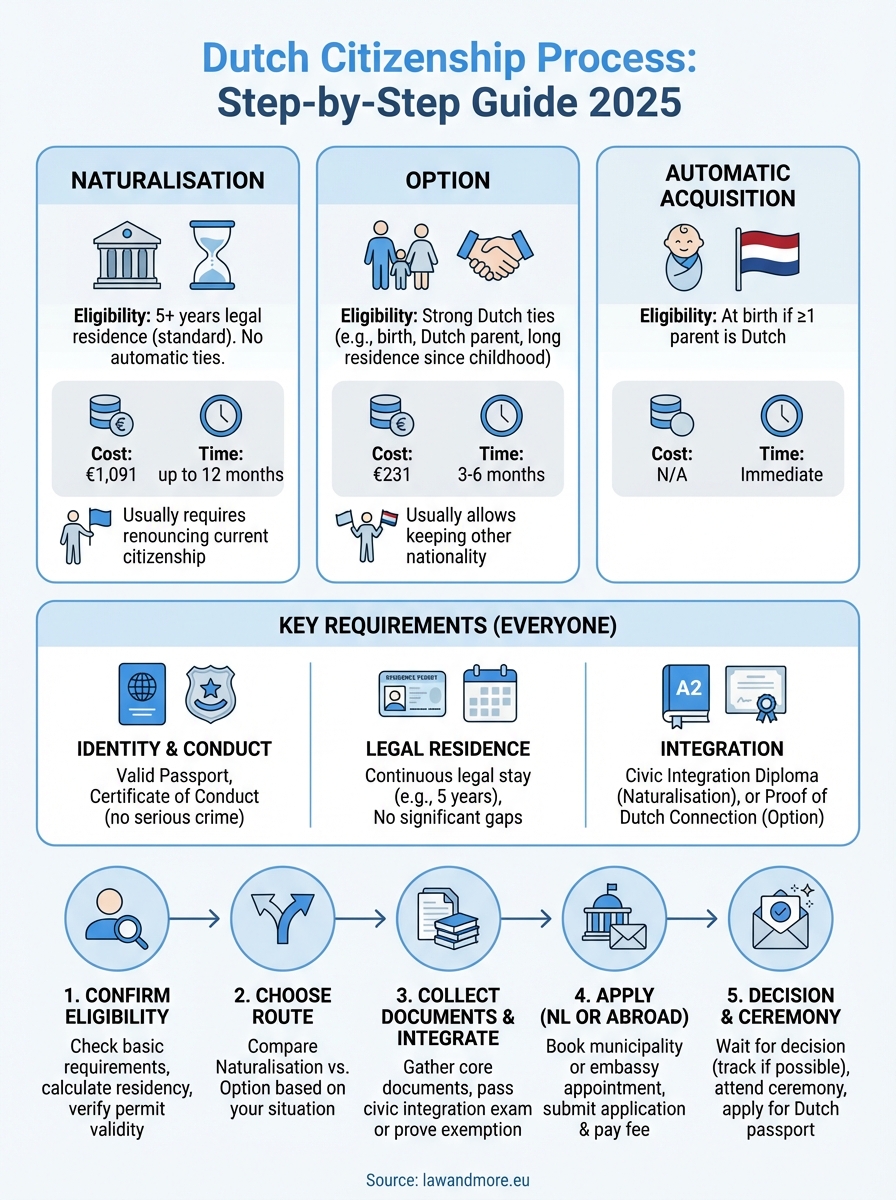
You can become Dutch through naturalisation, option, or automatic acquisition. Naturalisation applies when you have lived legally in the Netherlands for at least five years. Option works for people with strong Dutch ties, such as being born here or having a Dutch parent. Automatic acquisition happens at birth when at least one parent is Dutch.
Most applicants follow the naturalisation route because they do not qualify for option. The option procedure costs €231 and takes three to six months. Naturalisation costs €1,091 and takes up to one year. Both require you to prove your identity, show legal residency, and demonstrate integration into Dutch society.
The route you choose determines which documents you need, how long you wait, and whether you can keep your other nationality.
What you must prove
Every application requires proof of identity, legal residence, and integration. You submit a valid passport, residence permits covering your time in the Netherlands, and either a civic integration diploma or exemption certificate. The municipality or IND checks your documents, verifies your background, and decides if you meet all conditions.
Your application must show you pose no threat to public order. Authorities review your criminal record through a certificate of conduct. They also confirm you have sufficient ties to the Netherlands and understand your responsibilities as a Dutch citizen.
Step 1. Confirm you are eligible
Before you start the dutch citizenship process, you must verify that you meet the basic requirements. The criteria differ slightly between naturalisation and option, but all applicants must prove their identity, show legal residence, and demonstrate they pose no threat to Dutch society. Checking your eligibility now prevents wasted time and application fees later.
Basic requirements everyone must meet
You must be at least 18 years old to apply independently. Your identity and nationality need verification through valid documents such as a passport or birth certificate. The IND or municipality also checks that you have not committed serious crimes or pose a security risk to the Kingdom of the Netherlands.
Your documents must prove legal residence in the Netherlands for the required period. The standard requirement is five consecutive years with valid residence permits. However, certain groups face shorter or longer waiting periods depending on their situation.
Your residence permit must have been valid without interruption for the entire period you claim.
Calculate your residency period
Start counting from the date your first valid residence permit began. Temporary permits for study or family visits may not count toward the five years. Check your permit history in the IND system to confirm which periods qualify.
Specific situations change the residency requirement:
- Stateless persons: Need only two years of legal residence
- Spouses of Dutch citizens: Can apply after three years of marriage and continuous residence
- Refugees: Must complete five years from refugee status grant date
- Former Dutch citizens: May reapply after one year of residence
Periods spent outside the Netherlands longer than six consecutive months can interrupt your residency count. Short trips for holidays or business usually do not affect your eligibility, but extended absences require explanation. Keep records of your travel dates, entry stamps, and return documentation.
Verify your permit validity
Review every residence permit you held during your time in the Netherlands. Gaps between permits or periods with invalid status reset your residency clock. Your permits must show you lived here continuously and legally for the full required period.
Request your residence history from the IND if you lack complete records. This official document lists all permits issued in your name, their validity periods, and any interruptions. You need this information to complete your application accurately.
Step 2. Choose between option and naturalisation
Your eligibility determines which route you follow in the dutch citizenship process. The option procedure applies to people with strong Dutch connections, such as birth in the Netherlands or Dutch parents. Naturalisation serves everyone else who has lived here legally for five years. You cannot choose freely between them because option only works when specific conditions apply to your situation.
The difference matters because option costs €231, takes three to six months, and lets you keep your other nationality in most cases. Naturalisation costs €1,091, takes up to one year, and usually requires you to renounce your current citizenship. Start by checking if you qualify for option before assuming you must naturalize.
When the option procedure applies to you
Option works when you have automatic ties to the Netherlands through birth, parentage, or long residence from childhood. You qualify for option if you were born before January 1, 1985, to a Dutch mother and non-Dutch father. This route also applies if your parent became Dutch through the option procedure for latent Dutch citizens.
Children born in the Netherlands who lived here until age four can apply through option. The same applies if a Dutch citizen acknowledged your parentage between April 1, 2003, and March 1, 2009, after your birth. Former Dutch citizens who lost their nationality and need to exercise EU citizenship rights also use the option procedure.
The option procedure processes faster and costs less because your Dutch connection already exists through family or birth.
Your municipality handles option applications, not the IND. The mayor makes the final decision based on your documents and background check. You attend the naturalization ceremony at your local city hall after approval.
When naturalisation is your route
Naturalisation applies when you have no automatic Dutch ties but have lived legally in the Netherlands for five years. This route serves most foreign residents who want Dutch citizenship through their residence history rather than family connections. You prove your integration through the civic integration exam and demonstrate you understand Dutch society.
The IND processes all naturalisation applications instead of municipalities. You submit your application at your local municipality office, but they forward it to the IND for review. Processing takes up to 12 months because the IND verifies your entire residence history, checks your criminal record internationally, and confirms you meet all requirements.
Compare both routes before applying
The procedures differ in cost, speed, and requirements. Option requires proof of your Dutch connection through birth certificates, parentage documents, or parent naturalization certificates. Naturalisation requires your complete residence permit history, civic integration diploma, and proof you will renounce your other nationality.
Check your situation against option criteria first. Most applicants discover they must naturalize because they lack the specific family or birth connections option demands. Contact your municipality to confirm which procedure applies before you start gathering documents.
Step 3. Collect documents and meet integration rules
Document preparation takes the most time in the dutch citizenship process. You need original documents with certified translations for anything not in Dutch, English, French, or German. Start gathering these at least three months before your planned application date. Integration requirements vary based on your route and background, so check which rules apply to you before booking language exams.
Core documents every applicant needs
Your application package must include proof of identity through a valid passport for every nationality you currently hold. Request a certificate of conduct from the police in every country where you lived for six months or longer during the past ten years. This document confirms you have no serious criminal record.
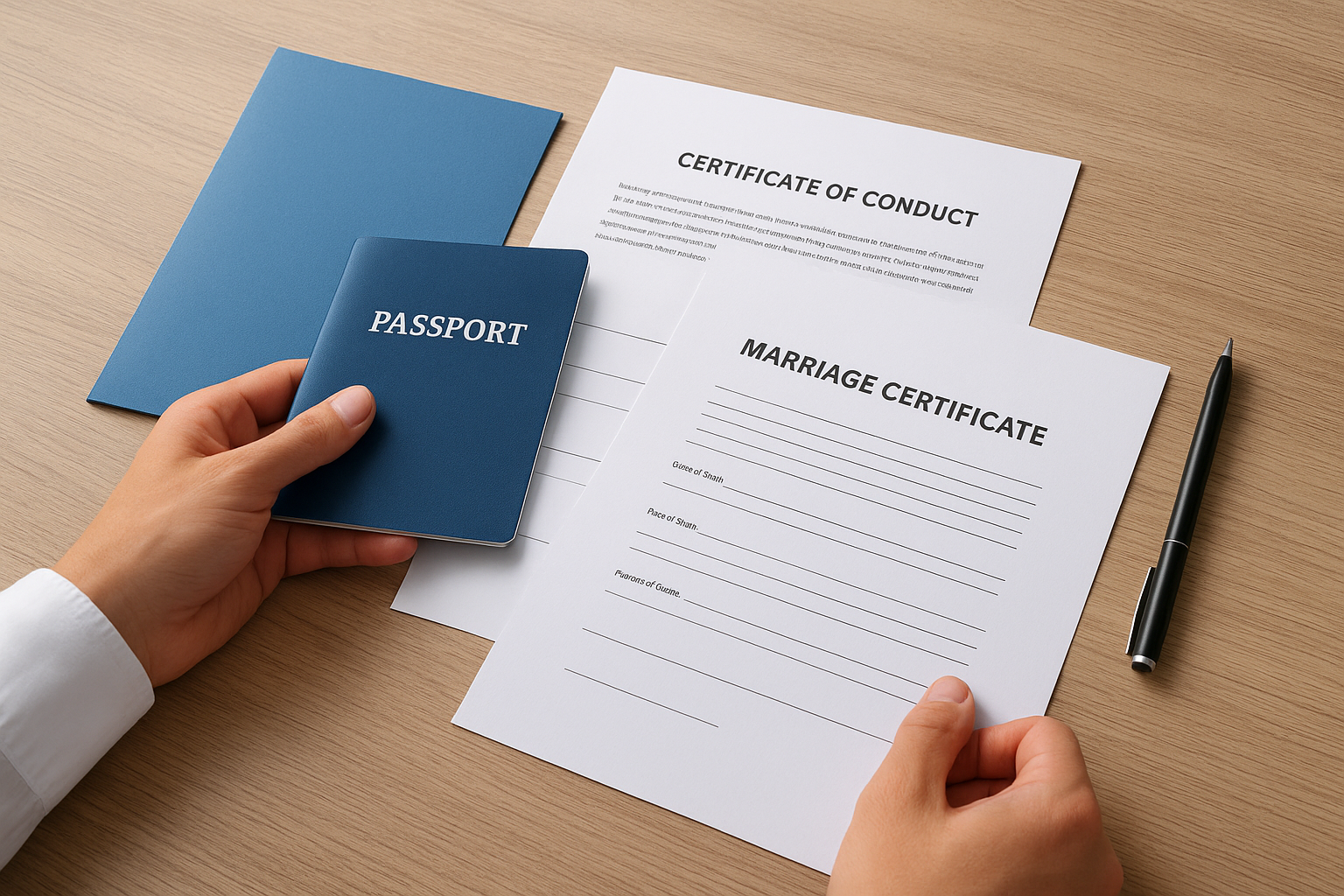
Collect certified copies of your birth certificate showing both parents’ full names and your place of birth. The certificate must be a complete official copy from the civil registry, not a hospital document. If you are married or divorced, include your marriage certificate or divorce decree with official translations.
Your residence history requires all residence permits you held in the Netherlands during your qualifying period. Request your official residence history from the IND if you lost any permit cards. This report lists every permit issued in your name, validity periods, and any status changes.
Original documents stay with you during the appointment, but the municipality or IND keeps certified copies for their file.
Additional documents for specific situations
Naturalisation applicants must provide their civic integration diploma or official exemption certificate. Option applicants substitute this with documents proving their Dutch connection, such as a parent’s Dutch passport from the time of your birth or their naturalisation certificate showing they became Dutch through the option procedure.
Children applying through a parent need proof of parentage through acknowledgement declarations if the Dutch parent is not listed on the birth certificate. Former Dutch citizens must show documentation of when and how they lost their nationality, such as a letter from the IND or their expired Dutch passport.
Meet integration requirements or prove exemption
The civic integration exam tests your Dutch language at A2 level and knowledge of Dutch society. You must pass five components: speaking, listening, reading, writing, and knowledge of Dutch society. Some applicants also complete the labour market orientation component depending on their situation.
Book your exam through DUO at least three months before applying. Processing your diploma takes four to six weeks after you pass all components. The exam costs approximately €150 per component, with most people needing multiple attempts.
Exemptions apply if you:
- Completed Dutch secondary education or higher education taught in Dutch
- Hold a degree from a Dutch educational institution
- Cannot participate due to a lasting physical or mental limitation
- Are 65 years or older at application time
Request exemption certificates from DUO by submitting proof of your education or medical limitation. Processing takes six to eight weeks, so apply early to avoid delays in your citizenship application.
Step 4. Apply in the Netherlands or abroad
You submit your application at a municipality office if you live in the Netherlands or at a Dutch embassy or consulate-general if you live abroad. Both locations require appointments, so book yours at least two weeks ahead. The application process follows the same steps regardless of location, but processing times vary based on which office handles your case.
Book your municipality appointment
Your local municipality processes both option and naturalisation applications if you live in the Netherlands. Visit your municipality’s website and search for “naturalisation appointment” or “Dutch citizenship appointment” to access their online booking system. Most municipalities use digital appointment platforms where you select available dates and times.
Bring your complete document package to the appointment along with payment. The municipality employee reviews your documents, completes the application form with you, and verifies your identity. You sign all required declarations during this meeting, so arrive with your valid passport and all original documents plus their certified copies.
Book your appointment only after you have all required documents ready because municipalities cannot reserve dates without complete applications.
Payment happens at the appointment through debit card only. Cash and credit cards are not accepted at most municipality offices. Confirm your municipality’s payment methods when booking to avoid delays on application day.
Apply through an embassy or consulate abroad
Foreign residents follow the dutch citizenship process through the Dutch diplomatic post in their country of residence. Contact the embassy or consulate-general by email or phone to schedule your appointment. Processing takes longer from abroad because documents travel between the diplomatic post and the Netherlands for verification.
Your appointment works the same way as a municipality visit. The consular officer reviews your documents, completes forms with you, and collects your application fee. You must travel to the diplomatic post in person because the officer needs to verify your identity and witness your signatures on legal declarations.
Prepare your appointment checklist
Bring these items to your application appointment:
- Valid passport for every nationality you hold
- Original documents with certified translations
- Certificate of conduct from relevant countries
- Civic integration diploma or exemption certificate
- Birth certificate and marriage documents if applicable
- Completed application forms (provided at appointment)
- Payment method (debit card for Netherlands, check embassy requirements for abroad)
Review your municipality or embassy website before your appointment for any location-specific requirements. Some offices request additional documents based on your individual situation.
Step 5. After you apply and get a decision
The dutch citizenship process enters a waiting period after you submit your application. You receive updates by mail at the address you provided during your appointment, so notify the municipality or IND immediately if you move. The decision letter explains whether your application succeeded and what you must do next.
Track your application status
Check your application progress through My IND if you applied via naturalisation. You need your V-number from your residence permit and the application reference number from your appointment receipt. Log in at the IND website to see which processing stage your application reached.
Option applications through municipalities lack online tracking. Your municipality contact person provides updates by phone or email if you request them. Most municipalities send one confirmation letter after receiving your application and then stay silent until they make a final decision.
You cannot speed up processing by contacting the IND or municipality repeatedly because each application follows a fixed review sequence.
Understand decision timelines
Naturalisation decisions arrive within 12 months from your application date. The IND extends this period by another 12 months only in complex cases requiring additional investigation. Option procedures through municipalities take three to six months depending on your situation and document complexity.
Processing delays happen when the IND or municipality needs to verify foreign documents, request additional information, or conduct extended background checks. You receive a written request if authorities need more documents or clarification about your application.
Respond to a positive decision
Your approval letter includes instructions for the naturalisation ceremony at your municipality. Book your ceremony date within three months of receiving approval. The ceremony lasts about 30 minutes and requires you to sign the Declaration of Solidarity in front of witnesses.

Apply for your Dutch passport one week after the ceremony at your municipality office or a city office branch. Bring your ceremony certificate, valid residence permit, and passport photos. Your residence permit expires after you receive your Dutch passport, so plan this timing carefully if you need to travel.
Handle a negative decision
File an objection notice within four weeks if the IND or municipality rejects your application. Submit your objection to the same office that made the decision, explaining why you disagree with their reasoning. Include new evidence that addresses the rejection grounds stated in your decision letter.
Consider consulting an immigration lawyer before filing your objection. Legal experts identify weaknesses in rejection decisions and strengthen your case with proper legal arguments. Your application fee is not refunded after rejection, but you can reapply once you fix the issues that caused the denial.
Wrap up and next steps
The dutch citizenship process requires preparation and patience, but following these five steps makes it manageable. You confirmed your eligibility, chose your route, collected documents, submitted your application, and now understand what happens next. Each stage builds on the previous one, and skipping steps causes delays.
Start by reviewing your residency history and determining whether option or naturalisation applies to you. Book your civic integration exam if required, then collect documents at least three months before applying. Contact your municipality to verify which documents they need for your case.
Complex situations benefit from legal guidance. Contact Law & More for immigration law advice if your residency includes gaps, you hold multiple nationalities, or your application was rejected. Their immigration lawyers help you prepare applications correctly and handle objections when decisions go wrong.