You receive a notice claiming content on your platform is illegal. Now you face a tough choice. Remove it too quickly and you might violate someone’s rights. Wait too long and you could face liability yourself. The Dutch legal system expects intermediaries to act, but the law doesn’t always spell out exactly how. Many online service providers struggle with this uncertainty. Some overreact and remove legitimate content. Others hesitate and risk legal consequences. Neither option protects your business or your users.
The Dutch Notice and Takedown Code of Conduct provides the framework you need. This voluntary industry standard outlines clear steps for handling reports of unlawful online content. Following the code helps you meet legal expectations while protecting your business from unnecessary risks. It gives you a defensible process when questions arise.
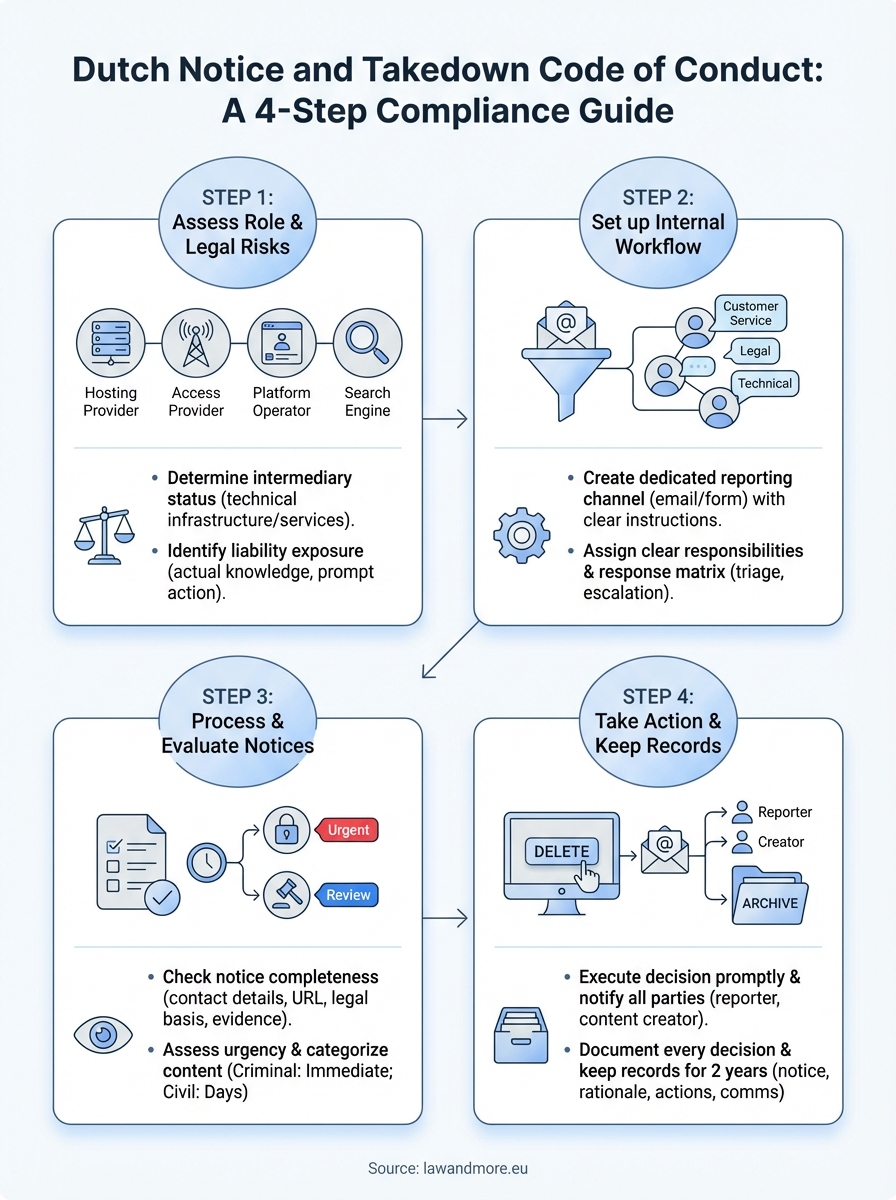
This guide breaks down the entire NTD compliance process into four practical steps. You’ll learn how to identify your legal position, create an efficient internal workflow, evaluate takedown notices correctly, and maintain proper documentation. By the end, you’ll have a clear roadmap for handling content removal requests under Dutch law.
What is the Dutch NTD code
The Dutch Notice and Takedown Code of Conduct establishes a standardized procedure for internet intermediaries to handle reports of unlawful content. This voluntary industry standard applies when someone notifies you about illegal information on your platform, service, or network. The code covers content that violates Dutch law, including criminal material like child exploitation imagery, fraud schemes, and copyright infringement.

Key principles of the code
The code requires you to act as a neutral intermediary, not a judge. Your responsibility is to process notices efficiently and make reasonable decisions based on the information provided. You must balance conflicting interests: the rights of the person reporting the content, the rights of the content creator, and your own legal obligations as a service provider.
The NTD code protects intermediaries who follow its procedures from liability for hosting unlawful content they didn’t create.
Under the code, you assess notices within specific timeframes, communicate your decisions clearly, and document your actions. The procedure recognizes that different types of content require different response speeds. Criminal content demands immediate action, while civil law violations allow more time for evaluation.
Step 1. Assess your role and legal risks
You need to determine whether the dutch notice and takedown code of conduct applies to your business before you implement any procedures. Not all online services fall under the code’s scope. The code targets intermediaries who provide public telecommunication or internet services, including hosting providers, access providers, search engines, and platform operators. Your first action is identifying your exact position in the online service chain.
Determine your intermediary status
Your business qualifies as an intermediary if you provide technical infrastructure or platform services that enable others to publish or distribute content. Hosting providers store content on their servers. Access providers connect users to the internet. Platform operators run marketplaces, forums, or social networks. Search engines index and display third-party content. Review your service agreements and technical setup to confirm which category applies to you.

Companies that create their own content or directly control what appears on their sites typically don’t qualify as intermediaries under the code.
Identify applicable legal obligations
Check your liability exposure under Dutch law. Intermediaries generally receive limited liability protection if they act promptly on illegal content notices. However, you lose this protection if you have actual knowledge of illegal content and fail to remove it. Your legal risk increases when you actively edit, select, or promote specific content. Document your current content moderation practices and compare them against the code’s requirements to spot compliance gaps.
Step 2. Set up an internal NTD workflow
Your organization needs a structured system to handle takedown notices consistently and efficiently. A clear internal workflow prevents missed deadlines, reduces legal risk, and ensures you comply with the dutch notice and takedown code of conduct. Start by mapping your current content handling processes and identifying where NTD procedures fit. Your workflow should connect your customer service team, legal department, and technical staff in a defined sequence.
Create a dedicated reporting channel
Establish a specific email address or web form exclusively for NTD notices. This dedicated channel separates urgent legal notices from general customer support requests. Display your contact information prominently on your website, typically in your terms of service or legal section. Include clear instructions about what information reporters must provide: their identity, the allegedly illegal content location, and the legal basis for removal.

You need these essential reporting elements:
- Full contact details of the reporting party (name, address, email, phone)
- Exact URL or location of the questioned content
- Description of why the content violates Dutch law
- Supporting evidence or documentation
- Statement of good faith and accuracy
Assign clear responsibilities
Designate a primary point person who receives and triages all incoming notices. This person evaluates urgency, forwards notices to the appropriate team members, and tracks response deadlines. Create a response matrix that specifies who handles each content type. Criminal content might require immediate escalation to your legal team and law enforcement, while copyright claims follow a different review path. Document these assignments in writing so staff know exactly what actions they must take when notices arrive.
Step 3. Process and evaluate notices
Your evaluation process determines whether you remove content or reject the notice. Every notice you receive requires systematic assessment against the dutch notice and takedown code of conduct criteria. You examine the notice for completeness, verify the legal basis, and determine response urgency. This step protects you from removing legitimate content while ensuring you act quickly on genuine violations.
Evaluate notice completeness
Check whether the reporter provided all required information before you begin substantive review. A valid notice must include the reporter’s full contact details, specific content location (exact URLs or identifiers), clear explanation of the legal violation, and supporting evidence. Incomplete notices require you to request additional information within two business days. Send a standard response template asking for specific missing elements:
Subject: Additional Information Required - NTD Notice [Reference Number]

We received your notice dated [DATE] regarding content at [URL].
To process your request, please provide:
- [Specific missing information]
- [Additional required details]

Please respond within 5 business days. We cannot process incomplete notices.
Assess urgency and categorize content
Classify each notice by legal severity and response timeframe. Criminal content (child exploitation, terrorism, fraud) demands action within hours. Copyright violations allow several days for review. Defamation claims need careful balance of competing rights. Create an urgency matrix that guides your response speed.
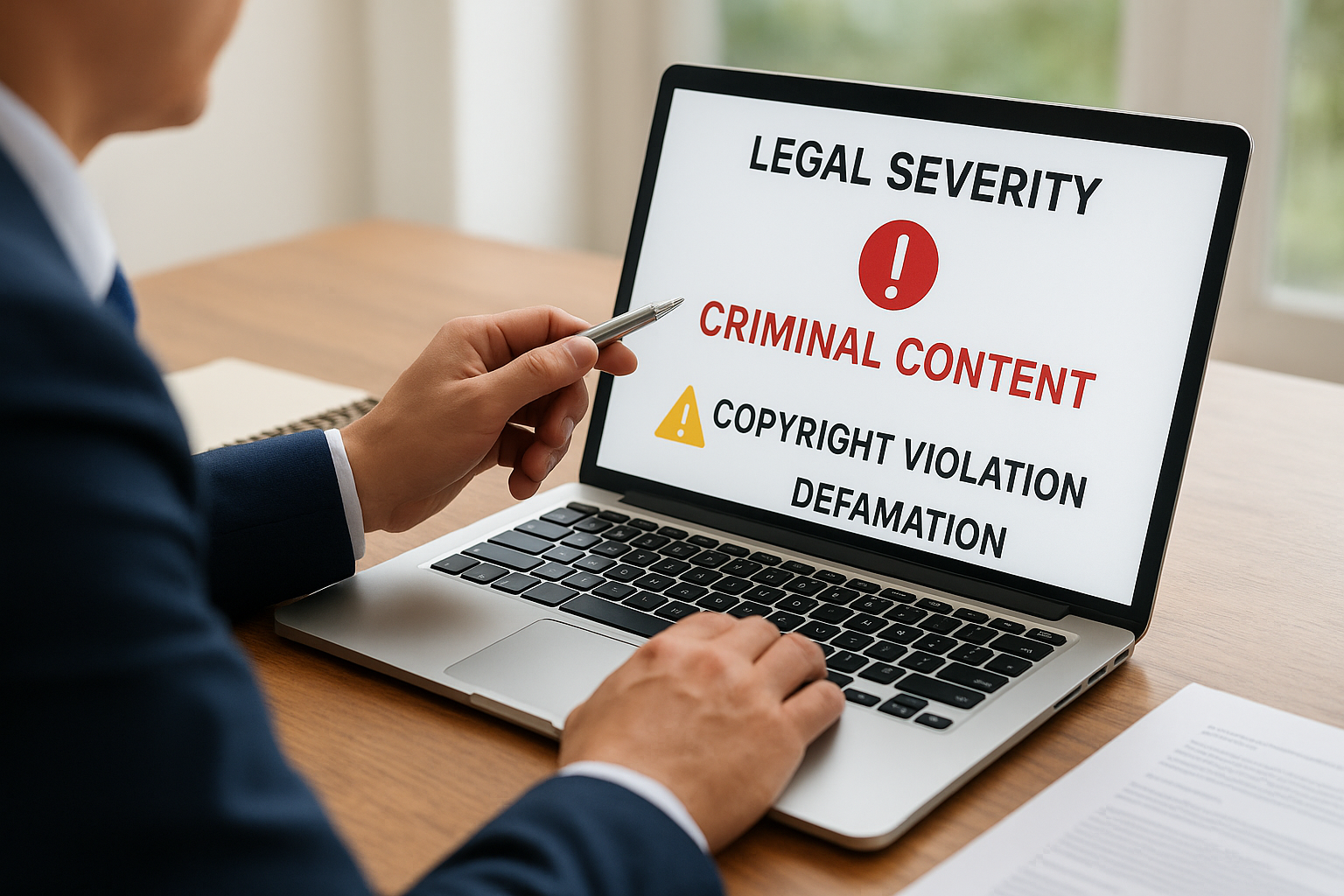
Response timeframes vary significantly: remove clearly criminal content immediately, evaluate civil law violations within 5-10 business days, and consult legal counsel for ambiguous cases.
Document your classification reasoning in your case management system. Note what evidence supports the alleged violation, whether the content clearly breaks Dutch law, and any factors that complicate your decision.
Step 4. Take action and keep records
Your evaluation leads to a concrete decision: remove the content, reject the notice, or forward it to the content creator. The dutch notice and takedown code of conduct requires you to act on this decision quickly and document everything. Your response time depends on content severity. Criminal material demands immediate removal within hours, while civil violations allow up to five business days. Execute your decision through your technical systems and communicate it clearly to all parties involved.
Execute your decision promptly
Remove content through your standard technical procedures when you determine it violates Dutch law. Disable access to the specific URL, delete files from your servers, or block the content from appearing in search results. Notify the reporter within 24 hours of taking action, including which content you removed and when. Contact the content creator simultaneously, explaining why you removed their material and providing them with the original notice. Give them five business days to submit a counter-notice if they believe the removal was wrong.
Document every decision
Create a detailed record for each notice you process. Your documentation protects you if questions arise later about your handling procedures. Save the original notice, your evaluation notes, timestamps of all actions, and copies of communications sent to both parties.
Store these essential records:
- Original takedown notice with all attachments
- Your decision rationale and supporting evidence
- Date and time of content removal or rejection
- Confirmation emails to reporter and content creator
- Any counter-notices received
- Final resolution details
Keep all records for at least two years after closing each case.
Next steps
You now have a complete framework for implementing the dutch notice and takedown code of conduct in your organization. Start by reviewing your current content policies and identifying any gaps in your compliance procedures. Update your terms of service to include your NTD contact information and response procedures. Train your staff on the evaluation criteria and response timelines outlined in this guide. Document your workflow decisions in writing.
Need legal support implementing these procedures? Law & More’s internet law specialists help Dutch businesses establish compliant NTD workflows and defend against unfounded takedown requests. Our team provides assistance with policy drafting, staff training, and dispute resolution when content removal decisions face legal challenges.