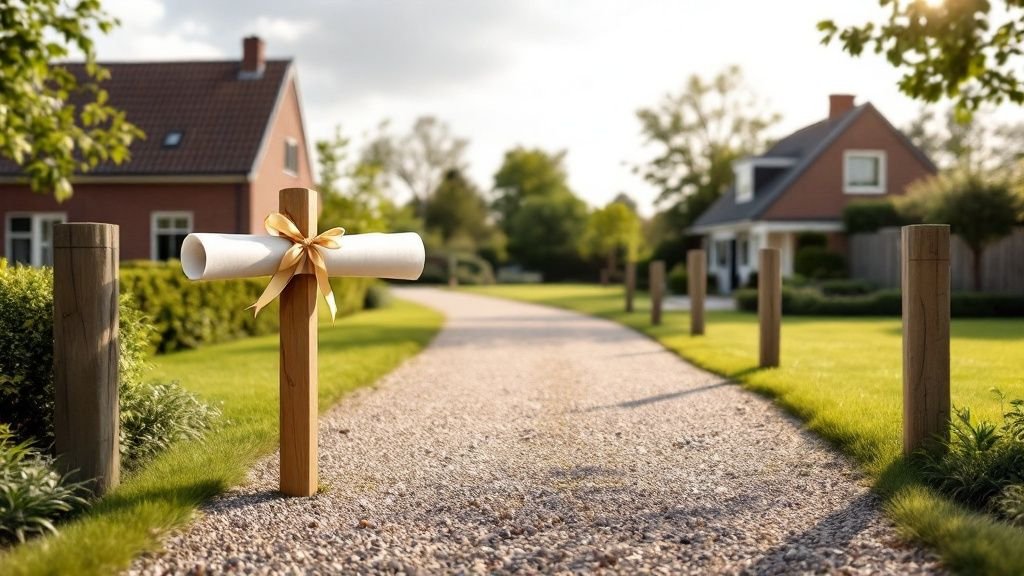
The Dutch legal principle of recht van overpad, or right of way, is a cornerstone of our property law. At its core, it gives a property owner the legal right to cross someone else's land to get to their own. Think of it as a guaranteed shortcut through a neighbour’s garden to reach a house that has no direct path to the main road. This established right ensures that land isn't left useless simply because it's landlocked.
The Foundation of Property Access in the Netherlands
Imagine you’ve found the perfect plot of land to build your dream home. There's just one big problem: it’s completely surrounded by other properties, with no direct access to a public road. This is where the importance of recht van overpad becomes crystal clear. Without this legal framework, your property would be inaccessible and, for all practical purposes, unusable.
A right of way creates a formal relationship between two properties, and each one plays a distinct role. Getting your head around these roles is the first step to understanding how the whole system works.
The Two Key Players
Every right of way agreement involves two essential parties, defined by the properties they own:
- Heersend Erf (Dominant Estate): This is the property that benefits from the right of way. It’s the landlocked plot that needs an access route to be reachable.
- Dienend Erf (Servient Estate): This is the property that grants the right of way. The owner of this land must allow the owner of the dominant estate to pass over a specific part of their property.

It’s important to realise this isn't just a casual favour between neighbours. It's a legally binding right attached to the land itself, not to the individuals who own it. This is a crucial distinction, as the right of way stays in place even when either property is sold to a new owner. The concept is deeply embedded in Dutch property law, which has its own unique characteristics. For a deeper look into property rights, exploring the nuances between ownership and leasehold can provide valuable context.
To help clarify these roles, here is a quick guide to the fundamental Dutch terms you'll encounter.
Table: Key Terms in Right of Way Law
| Dutch Term | English Translation | Role in the Agreement |
|---|---|---|
| Recht van overpad | Right of Way | The legal right to cross another's land for access. |
| Heersend erf | Dominant Estate | The property that benefits from and uses the right of way. |
| Dienend erf | Servient Estate | The property over which the right of way is granted. |
| Erfdienstbaarheid | Easement | The broader legal term for a burden on one property for the benefit of another. |
Understanding this terminology is the first step to navigating any right of way agreement confidently.
Why These Rules Are So Widespread
In a densely populated country like the Netherlands, making efficient use of land is absolutely critical. The recht van overpad is a practical solution that prevents plots from becoming isolated and unusable. In fact, it's estimated that approximately 10-15% of rural properties in the Netherlands involve some form of right of way agreement, a figure that reflects our country's often fragmented land ownership patterns. This shows just how common and necessary these rules are for daily life and commerce, particularly in agricultural areas.
This legal structure affects everyone, from homeowners needing a path to their back gardens to farmers requiring routes to access their fields. Understanding these legal property aspects is vital when planning any construction, as these details often appear on a comprehensive building permit checklist. Ultimately, it forms the bedrock of accessible property ownership, turning potentially isolated plots into valuable, functional assets.
How a Right of Way is Legally Created
A right of way isn't just a friendly handshake agreement between neighbours. It's a formal legal right that has to be created through specific, legally recognised methods. Getting this right is crucial, because an informal arrangement can be revoked at any time, potentially leaving a property owner without vital access.
Under Dutch law, there are really two main routes to establish a permanent and enforceable recht van overpad. The most common is through mutual agreement, locked in by a formal legal document. But rights can also emerge over time through consistent, long-term use—a concept known as prescription. Each path has its own set of rules you need to follow.

Establishment Through a Notarial Deed
By far the clearest and most reliable way to create a recht van overpad is through vestiging, or establishment, via a notarial deed. This is a proactive step taken by the owners of both the dominant and servient properties. They simply agree on the terms and hire a civil-law notary (notaris) to make it official.
The process is straightforward and involves a few key steps:
- Agreement: The property owners sit down and agree on the specifics. This means hashing out the exact path, what kind of use is allowed (foot traffic only? vehicles?), and any rules about things like maintenance or gates.
- Notarial Deed: A notary then drafts the official deed of establishment (akte van vestiging). This is the legal document that describes the easement, identifies the two properties, and lays out all the conditions you've agreed upon.
- Registration: Finally, the notary submits the deed to the Dutch Land Registry, the Kadaster. This last step is non-negotiable.
Registration with the Kadaster is what makes the right of way a public record. It legally attaches the right to the property itself, not just the current owners. This ensures it stays in place even when the properties are sold. Without it, you just have a personal contract that offers no long-term security.
This formal registration is surprisingly common. Data from the Dutch Kadaster shows that statutory easements like recht van overpad are formally registered in roughly 7% of all property titles across the Netherlands. With over 8 million registered parcels nationwide as of 2023, that works out to around 560,000 properties with formal passage rights on the books. You can learn more about how Dutch land administration works in this detailed overview from the OECD.
Acquisition Through Prescription
What happens if there's no deed? Sometimes, a right of way can be created through a process called verjaring, or prescription. This happens when someone uses a path across another person's land for such a long and uninterrupted period that they eventually gain a legal right to keep doing so. The law splits this into two different scenarios.
Acquisitive Prescription in Good Faith
This is when someone uses a path for 10 continuous years while genuinely and reasonably believing they have the legal right to do so. This is known as acting in good faith (te goeder trouw).
Imagine a homeowner whose old purchase agreement mentioned a right of way, but for some reason, it was never officially registered with the Kadaster. If they use that path openly for a decade, relying on that old agreement, they can acquire the right through prescription.
Extinctive Prescription in Bad Faith
Here’s where it gets interesting. A right of way can also be acquired even if the user knows they don't have a formal right. This is acting in bad faith (te kwader trouw).
If someone uses a path over their neighbour’s land openly and continuously for 20 years, the original owner’s legal right to object simply "expires." After two decades of uninterrupted use, the user can go to court and legally claim a recht van overpad has been established.
Of course, proving prescription can be a real challenge. The person claiming the right has the burden of proof, and they need to supply solid evidence of continuous, uninterrupted, and unambiguous use. This might mean digging up old photos, finding witness statements, or showing records of path maintenance. Courts are often very strict in their assessments, which is why the notarial deed is always the safer, more certain method.
Defining the Rights and Duties of Each Owner
A recht van overpad is much more than just a simple permission slip to cross someone else's land. It’s a formal legal relationship, built on a foundation of mutual rights and responsibilities that both parties need to understand. Getting this balance right is the key to preventing the kind of disputes that can quickly turn neighbours into adversaries.
Think of it like sharing a tool. The person borrowing it has the right to use it for its intended purpose, but they also have a duty to look after it. They can't use it in a way that damages it or creates a major hassle for the owner. At the same time, the owner has to make the tool available as agreed, even while they still own it and control their property.

This legal framework ensures the access one person gets doesn't become an unfair burden on the property owner providing it. Let's break down exactly what Dutch law expects from each party.
Responsibilities of the User (Dominant Estate)
The owner of the dominant estate (heersend erf)—the one who benefits from the access—has the primary job of being a good steward of this right. All their obligations essentially boil down to respecting the other person's property.
The golden rule is that the right of way must be used in the least burdensome way possible (op de minst bezwarende wijze). This principle shapes everything the user does. If the right of way is a path through a garden, for instance, you can’t suddenly decide to host a picnic on it or park your car there. The access is strictly for getting from A to B.
Key duties for the user include:
- Maintenance: In most cases, the user is on the hook for the path's upkeep. This means keeping it safe and usable, not just for themselves but also to prevent damage to the surrounding land. If a path gets muddy and starts eroding, it's the user's job to fix it.
- Adhering to Scope: You can't expand the use of the path beyond what was originally agreed upon in the deed. A right of way established for foot traffic can't suddenly be used for heavy farm machinery without causing a legal headache.
- No Unnecessary Hindrance: The user must not do anything that gets in the way of the other owner's enjoyment of their own property. Simple things, like leaving gates open, making excessive noise, or dropping litter on the path, are definite no-gos.
Obligations of the Provider (Servient Estate)
While the servient estate (dienend erf) has the burden of the easement, the owner isn't left without rights. Their main obligation is straightforward but absolute: they cannot obstruct the user's rightful access. This is the core of their duty.
This means they can't decide to build a shed on the path, plant a tree in the middle of it, or do anything else that makes passage impossible. But this doesn't mean they lose all control. The owner of the servient estate has specific rights that help balance the scales.
A classic point of conflict is the installation of a gate. The owner of the servient property is perfectly within their rights to install a gate for security reasons. However, they must provide the user with a key or some other form of easy, continuous access. A locked gate without a key is an illegal obstruction, plain and simple.
The provider also has another important right under Dutch law: they can ask to relocate the path. If the current location of the right of way becomes a major inconvenience—say, it’s preventing a planned home extension—the owner can designate a new route. This is only allowed if the new path provides equally convenient access and puts the user at no disadvantage.
This careful balance of duties is designed to make the whole arrangement workable. It gives the user the access they need while protecting the provider’s fundamental right to enjoy and manage their own land.
How to Handle Common Disputes and Legal Issues
Even with the clearest of agreements, the shared nature of a recht van overpad can easily lead to friction between neighbours. What starts as a minor disagreement can quickly spiral into a stressful and complex legal battle if it isn't handled with care. Knowing the common sticking points and the right way to approach a resolution is key to protecting your rights and keeping the peace.
Disputes often pop up from simple misunderstandings or when circumstances change over time. One person might feel the path is being used far more heavily than originally intended, perhaps with commercial vehicles. Another classic issue is obstruction—a new gate is installed, but no key is provided, or garden furniture slowly starts to take over the walkway. And of course, arguments over who should pay for upkeep are a frequent source of conflict.

These aren't just petty squabbles; they can have serious financial and legal ramifications. A 2018 report highlighted that disagreements over rights of way were behind nearly 4% of all real estate litigation cases across the Netherlands. The average dispute dragged on for about nine months, with legal costs hitting an average of EUR 7,500 per party.
Your Path to Resolution, from Negotiation to Court
When a conflict arises, jumping straight to legal action is rarely the best move. It's much better to take a structured, escalating approach that gives both sides a chance to find a reasonable solution before the lawyers and courts get involved. The real goal is to find a fix that is both practical and legally sound.
This process can generally be broken down into three main stages:
- Direct Negotiation: The simplest and cheapest solution is always to talk it out. A calm, face-to-face conversation with your neighbour can often clear up the whole issue. It helps to come prepared with a copy of the notarial deed so you can both refer back to the specific terms of the agreement.
- Mediation: If talking directly doesn't work, bringing in a neutral third party can make all the difference. This could be a local mediation service (buurtbemiddeling) or a professional mediator. They don't take sides but instead guide the conversation towards a compromise that everyone can live with.
- Litigation: Taking the matter to court is the last resort. It's the most expensive and time-consuming path, but it becomes necessary when one party is clearly violating the terms of the easement and simply refuses to cooperate.
A crucial piece of advice: the aim is to resolve the issue, not to win an argument. Keeping communication open and respectful at every stage dramatically increases the odds of a positive outcome without the huge cost and stress of a legal fight.
When disagreements over a recht van overpad get serious, finding a way forward is critical. Below is a look at the different paths you can take to resolve the conflict.
Dispute Resolution Options for Right of Way
| Resolution Method | Average Cost | Typical Timeframe | Best For |
|---|---|---|---|
| Direct Negotiation | Minimal to none | A few days to weeks | Simple misunderstandings and minor issues where neighbours have a reasonable relationship. |
| Mediation | €150 – €400 per hour (shared) | 2-6 weeks | When direct talks have stalled but both parties are still willing to find a compromise. |
| Litigation (Court) | €5,000 – €15,000+ per party | 6-18 months | Complex disputes, clear breaches of the deed, or when one party is completely uncooperative. |
| Binding Advice | €1,000 – €3,000 | 1-3 months | When a quick, legally binding decision is needed without a full court procedure. |
Each option has its place, and choosing the right one depends entirely on the specifics of your situation and your neighbour's willingness to cooperate.
Building Your Case: The Importance of Evidence
If you find yourself heading toward mediation or, worse, litigation, your success will hinge on the evidence you've gathered. Your word against theirs is rarely enough; you need to back up your claims with clear, objective proof.
You should start collecting this evidence the moment a problem arises. Good documentation is your strongest ally in proving that the terms of the recht van overpad have been broken.
Here are the key types of evidence to focus on:
- Photographic and Video Evidence: Take dated photos or videos of any blockages, damage to the path, or improper use. This creates an undeniable visual record of the problem over time.
- Witness Statements: Statements from other neighbours, delivery people, or regular visitors who have seen the issue firsthand can provide powerful, independent corroboration.
- Official Documents: The most important piece of evidence is the notarial deed registered with the Kadaster. This document is the final word on the specific rights and responsibilities of each party.
- Written Communication: Keep a careful record of every email, letter, or text message you've exchanged about the dispute. This trail shows your good-faith attempts to resolve the matter amicably.
Sometimes, these issues can get more complicated. If a neighbour's actions involve more than just an obstruction and include actual construction, it’s worth understanding the legal options if your neighbours build without a permit, as these problems can overlap. By systematically gathering your evidence, you build a solid case that strengthens your position, whether you're sitting down at the negotiation table or standing in a courtroom.
Changing or Ending a Right of Way Agreement
A right of way is a durable legal right tied to a property, but that doesn't mean it’s set in stone forever. Circumstances can change dramatically over time. A new road might be built, giving a once-landlocked property its own direct access, or the original reason for the path might simply become obsolete. When this happens, Dutch law provides clear routes for modifying or even completely terminating a recht van overpad.
These changes aren't made lightly, as they touch upon fundamental property rights. But when an agreement no longer serves its original purpose or has become an unreasonable burden, the legal system offers solutions. The process can be as simple as a mutual agreement or as formal as a court procedure, depending entirely on the situation and whether both property owners are willing to cooperate.
The Power of Mutual Agreement
The most straightforward way to change or end a right of way is through mutual consent. If the owner of the dominant estate and the servient estate both agree the arrangement is no longer needed or requires an update, they can formalise this decision. It’s essentially the reverse of how a right of way is created.
This requires a few key steps:
- Mutual Consent: Both parties must be in complete agreement about the termination or modification.
- Notarial Deed: A civil-law notary must draft a new deed, known as an akte van opheffing (deed of cancellation), that officially ends the easement.
- Kadaster Registration: This new deed has to be registered with the Land Registry (Kadaster) to legally scrub the easement from the property titles.
If you skip that final registration step, the agreement is just a personal contract between the current owners. It won't be binding on any future buyers. A formal, registered agreement is the cleanest way to dissolve the arrangement, which mirrors the importance of proper procedure in any contract termination. You can find more details on the general principles of terminating contracts in our comprehensive guide on the dissolution of an agreement.
Seeking Termination Through the Courts
So, what happens when one owner wants out, but the other doesn't agree? In these more complicated scenarios, the owner of the servient estate can petition a court to have the easement lifted. A judge won't grant this kind of request without a very compelling reason.
The Dutch Civil Code outlines specific grounds on which a court can order the termination of a right of way.
Under the law, a judge may terminate an easement if its continued existence provides no reasonable benefit (redelijk belang) to the owner of the dominant estate, and it is not plausible that this benefit will return in the future.
This means the court will take a hard look at the practical reality. For example, if the dominant property now has its own direct access to a public road, the original justification for the right of way has probably vanished. The court has to be convinced that the user genuinely no longer needs the path.
A court can also terminate a right of way if its use has become impossible or if unforeseen circumstances make its continuation unreasonable. In some cases, to balance the interests of both sides fairly, a judge might order the owner of the servient estate to pay financial compensation to the other party for the loss of their right.
Your Top Right of Way Questions, Answered
When you're dealing with a recht van overpad, the official rules are one thing, but how they play out in the real world is another. Let's tackle some of the most common questions that pop up for property owners, breaking down what your rights and responsibilities actually look like on the ground.
Can the Path Be Blocked by a Gate?
This is a classic point of friction. Can the owner of the property being crossed put up a gate or a fence? The short answer is yes, but there's a huge "but" attached.
The owner of the dienend erf (the servient property) is perfectly within their rights to secure their land, and that includes installing a gate. The critical condition, however, is that this gate cannot unreasonably get in the way of the dominant property owner's access. This means they must provide a simple and continuous way to get through. Think a key, a remote, or a keypad code.
If opening the gate becomes a major hassle or significantly slows down access, it could be legally viewed as an unlawful obstruction. The law is trying to strike a fair balance here: the servient owner gets their security, and the dominant owner gets the easy access they were guaranteed.
Who Is Responsible for Maintaining the Path?
Another frequent source of neighbourly disputes is upkeep. Who foots the bill for repairs? Unless the notarial deed specifically lays out a different arrangement, the responsibility for maintenance rests with the owner of the dominant estate—that's the person who actually uses the path.
This isn't just about keeping the path looking nice. The user has a duty to maintain the path in a state where it doesn't cause any harm to the servient property. For example, if the path erodes and starts causing water to flood the neighbour's garden, the user is on the hook to fix it.
Of course, if both property owners use the path regularly, it makes sense to share the maintenance costs. The best way to head off arguments down the line is to get these maintenance duties clearly defined in the original notarial deed from the very start.
What Kind of Use Is Permitted?
A right of way isn't a free-for-all; its use is strictly limited by how it was first established. The original purpose detailed in the deed is the ultimate authority.
- If the deed specifies a voetpad (footpath), it's for walking only. Simple as that.
- If it mentions a weg (road or way), that generally implies it can be used by vehicles like cars.
- If the right was created for agricultural purposes, it’s fair to assume it can handle tractors and other farm equipment.
The key takeaway is that the user can't just decide to change how they use the path or ramp up the intensity. A right of way set up for the occasional trip to a holiday cottage can't suddenly be used for a fleet of heavy construction vehicles building a new housing estate. That kind of major change is a burden the servient property owner can legally challenge.
The core idea is that the burden on the servient property should not be increased beyond what was originally intended or agreed upon when the right of way was created. Any changes must be reasonable and consistent with the original purpose.
What Happens When a Property Is Sold?
Here's one of the most powerful features of a recht van overpad: it's a zakelijk recht, or a "real right." This means the right is attached to the land itself, not the person who owns it. This is a crucial detail when a property changes hands.
The right of way simply transfers with the property.
- If the servient property is sold, the new owner is legally stuck with it. They have to honour the existing right of way and can't just get rid of it.
- If the dominant property is sold, the new owner automatically gets the benefit of the right of way and can use it just like the previous owner did.
This is precisely why formally registering the notarial deed with the Kadaster is so vital. It makes the right of way a public, searchable fact, putting any potential buyer of either property on notice. It locks in that long-term security and clears up any confusion when ownership changes. Without that official registration, the agreement might just be seen as a personal promise that vanishes when the property is sold.