
Getting a self-employment visa in the Netherlands is tough. The success rate sits around 13% for applications filed inside the country and only 7% for applications from abroad. The Dutch immigration authorities use a points-based test that looks objective on paper but involves considerable subjective judgment. Many qualified entrepreneurs get rejected because they miss key requirements or fail to present their business case the right way.
You can succeed if you know exactly what the IND and RVO expect from your application. The process requires more than just a business plan. You need to prove your business serves a Dutch interest, meet specific income thresholds, and provide extensive documentation that supports every claim you make.
This guide walks you through the complete application process for 2026. You’ll learn who qualifies, what documents to prepare, how to build a business case that passes the points test, and what happens after you submit your application. We cover the MVV requirement, costs, processing times, and practical steps to maximize your approval chances.
What the Dutch self-employment visa is
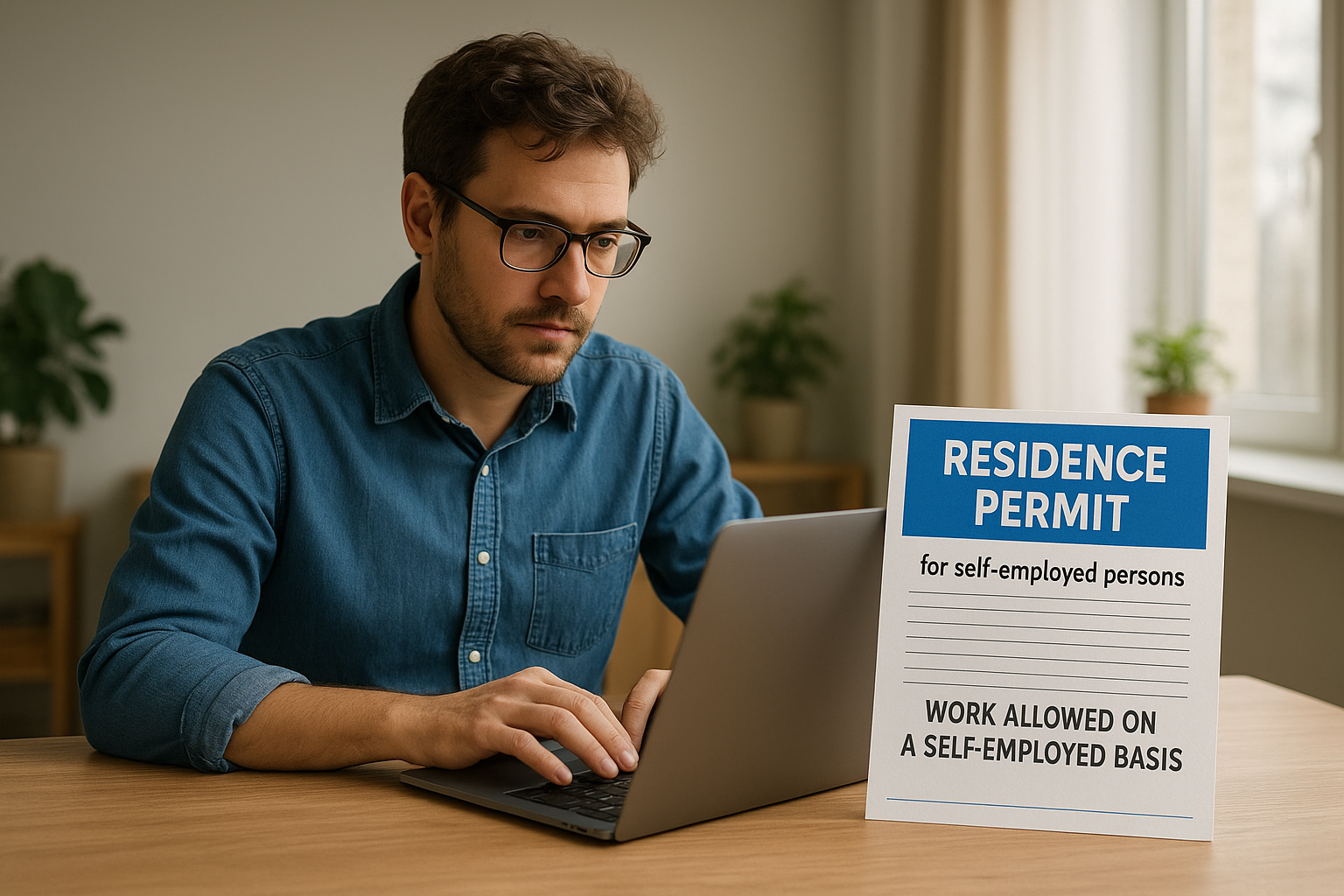
The Dutch self-employment visa is officially called a residence permit for self-employed persons (in Dutch: verblijfsvergunning voor zelfstandigen). This permit allows non-EU/EEA/Swiss nationals to live and work in the Netherlands as independent entrepreneurs. You need this permit if you want to run your own business, work as a freelancer, or operate as an independent contractor from the Netherlands.
Who issues it and what it allows
The Immigration and Naturalization Service (IND) processes your application together with the Netherlands Enterprise Agency (RVO). The IND handles the residence permit aspects while the RVO evaluates whether your business serves a Dutch interest. Once approved, your self employment visa netherlands permit states "work allowed on a self-employed basis, free to work, no work permit required" on the back.
Your business must serve an essential Dutch interest to qualify for approval.
Your permit initially lasts two years and allows you to work only as a self-employed person. You cannot take on regular employment unless your employer obtains a separate work permit for you. After five years of continuous legal residence, you become eligible to apply for permanent residence.
Step 1. Confirm you qualify in 2026
You must meet several baseline requirements before you can apply for a self employment visa netherlands permit. The Dutch immigration system filters applicants through eligibility criteria first, then evaluates your business plan through a points-based assessment.
Basic eligibility criteria
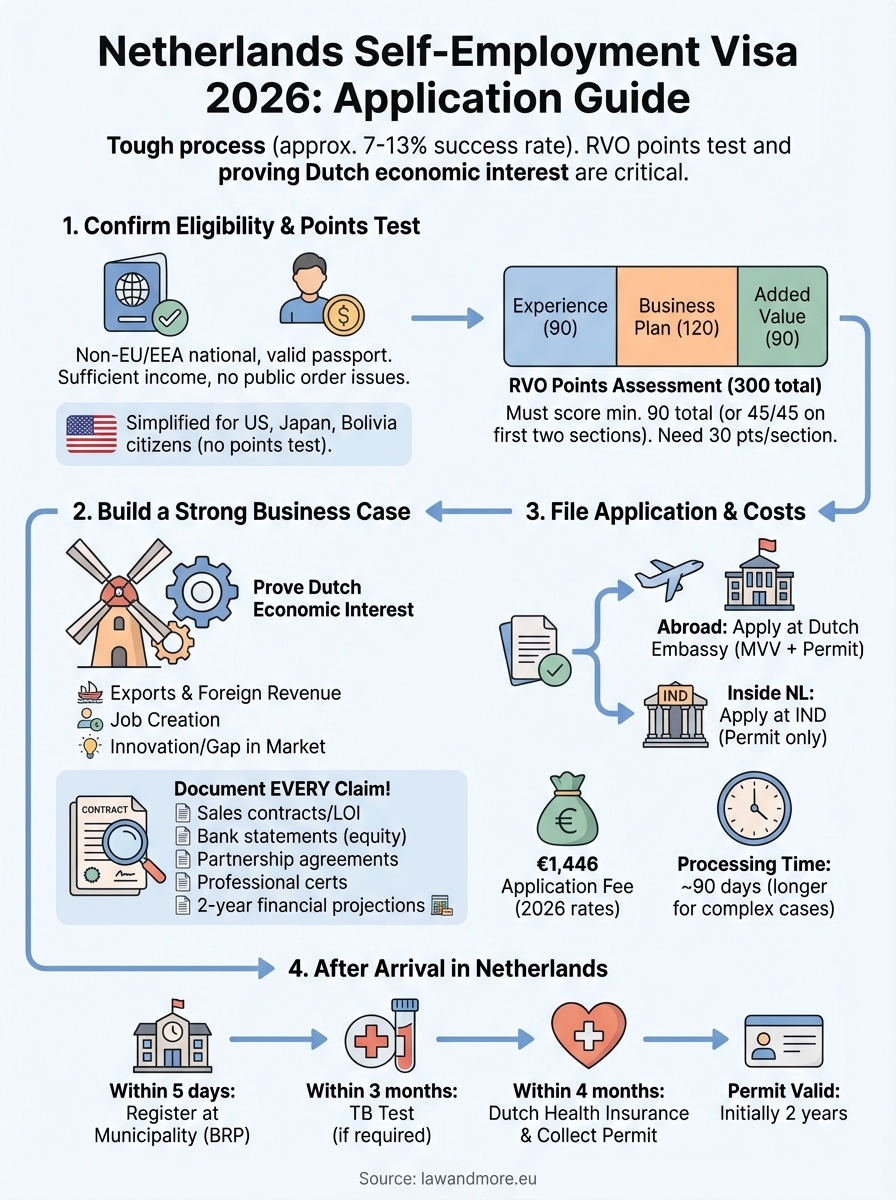
You need a valid passport from a country outside the EU, EEA, or Switzerland. Your passport must remain valid throughout your intended stay. You also need to meet general conditions that apply to all residence permits, including having no public order concerns and sufficient income to support yourself without relying on Dutch public funds.
Citizens of the United States, Japan, and Bolivia follow a simplified procedure that skips the points test. If you hold one of these nationalities, the RVO assesses your application based on whether your business serves a Dutch economic interest without using the point system. All other nationalities go through the full points-based evaluation.
The points-based assessment
The RVO evaluates your business plan using a 300-point system divided into three sections: personal experience (maximum 90 points), business plan quality (maximum 120 points), and added value to the Netherlands (maximum 90 points). You must score at least 30 points in each section and reach a total of 90 points to pass. Alternatively, you can score 45 points on the first two sections and automatically pass the third.
The RVO requires supporting documents for every point you claim in your application.
Current income thresholds
Your business must generate enough income to support you financially. From June 30, 2025 through December 31, 2025, you need to show an average gross profit of €1,697.82 per month. Your bookkeeper must provide income projections for the two-year validity period of your permit. These projections need to demonstrate that your business will consistently meet or exceed this threshold.
Step 2. Build a strong business case
Your business plan determines whether the RVO approves your self employment visa netherlands application. The RVO evaluates your plan against strict criteria and requires concrete evidence for every claim you make. A weak business case leads to rejection, even if you meet all other requirements. Your goal is to show that your business serves an essential Dutch interest and has realistic financial prospects.
Prove Dutch economic interest
The RVO prioritizes businesses that benefit the Netherlands economy, culture, or society. You need to demonstrate your business creates value beyond your personal income. Export activities that bring foreign revenue into the Netherlands score well. Job creation for Dutch residents, even if planned for future years, strengthens your case. Innovation in your field or filling a gap in the Dutch market also counts favorably.

Concrete examples work better than vague statements. Instead of writing "my business will help the Dutch economy," explain "my trading company will generate €200,000 in export revenue by connecting Dutch manufacturers with Asian distributors." If you received an invitation from a publicly funded Dutch cultural organization or won a grant from institutions like the Mondriaan Fund or Performing Arts Fund, include this documentation. These endorsements carry significant weight with the RVO.
Document every claim with evidence
The RVO rejects claims you cannot prove with supporting documents. Sales contracts, memoranda of understanding, and letters of intent verify your revenue projections. Bank statements confirm your equity contributions. Partnership agreements validate collaboration claims. Professional certifications back up your expertise statements.
| Claim in business plan | Required evidence |
|---|---|
| €50,000 first-year revenue | Signed contracts or detailed client letters of intent |
| €25,000 startup capital | Bank statement showing full amount in accessible account |
| Partnership with Dutch firm | Signed partnership agreement with company details |
| Industry expertise | Diplomas, certifications, reference letters from past employers |
Missing documentation gives the RVO reason to deny points you need.
The RVO will find reasons to reject undocumented claims, regardless of how credible your business appears.
Create financial projections
Your bookkeeper must prepare detailed two-year income projections that show monthly gross profit exceeding €1,697.82. These projections need to break down revenue sources, costs, and profit margins by quarter. Include best-case and realistic scenarios. Base all numbers on verifiable assumptions tied to your supporting documents.
Step 3. File your application correctly
You need to submit your self employment visa netherlands application through specific channels depending on where you currently live. The application process differs significantly for applicants inside the Netherlands versus those abroad. Getting the location and documentation right prevents delays and rejections.
Where to apply
Applicants living abroad must apply at the Dutch embassy or consulate in their country of residence or nationality. You apply for both the MVV (provisional residence permit) and residence permit simultaneously. The embassy forwards your application to the IND, which then requests advice from the RVO. You cannot enter the Netherlands until you receive your MVV approval.
Applicants already in the Netherlands on another valid residence permit (such as a student permit or orientation year permit) can switch to a self-employment permit by submitting their application directly to the IND. You do not need an MVV in this case.
Required documents checklist
Your application must include certified and translated documents in Dutch, English, French, or German. Prepare these materials before you submit:
| Document category | Specific items required |
|---|---|
| Identity | Valid passport, passport photos |
| Business | Chamber of Commerce registration, detailed business plan with RVO point claims |
| Financial | Bank statements showing equity, two-year income projections from bookkeeper |
| Supporting | Sales contracts, partnership agreements, professional certificates, invitation letters |
The IND rejects incomplete applications and requires you to resubmit with all documents.
Costs and processing times
The application fee is €1,446 for MVV plus residence permit applications (2026 rates). The IND processes most applications within 90 days, though complex cases involving RVO assessment can take longer. Track your application status through the IND portal after submission.
Step 4. After you arrive in the Netherlands
Your responsibilities begin immediately after you arrive with your approved self employment visa netherlands permit. The Dutch government requires you to complete several registration steps within specific timeframes. Missing these deadlines can affect your residence status and access to essential services.
Register with local municipality
You must register in the Municipal Personal Records Database (BRP) at your local municipality within five days of arrival. Book an appointment online through your municipality’s website. Bring your passport, residence permit approval letter, and proof of address (such as a rental contract). The municipality issues a BSN (citizen service number) that you need for banking, taxes, and healthcare.
Complete health requirements
Schedule an appointment with your local Area Health Authority (GGD) within three months to undergo a tuberculosis test if your country of origin requires it. You must also obtain Dutch health insurance within four months of arrival. Contact Dutch health insurers directly to compare plans and enroll. Finally, book an appointment at an IND desk to collect your physical residence document.
Your residence permit becomes invalid if you fail to collect your residence document within the stated deadline.
Next steps
You now have a complete roadmap for applying for the self employment visa netherlands in 2026. The process demands detailed preparation, strong documentation, and a business plan that proves Dutch economic interest. Start by confirming your eligibility, then gather your supporting documents before you invest time in writing your business plan.
Immigration law changes frequently and the RVO’s assessment standards can shift without notice. Professional legal guidance helps you avoid costly mistakes that lead to rejection. Law & More’s immigration lawyers specialize in Dutch residence permit applications and can review your business case before submission. Get expert help with your application to maximize your approval chances.